
How the Adapter Design Pattern Can Help Your Code Work Together Seamlessly
Discover how the Adapter Design Pattern helps incompatible code work together, simplifying integration with third-party APIs, legacy systems, and multiple services
Stateless 🤯
8/19/2024


Ever had a situation where two pieces of code just wouldn’t work together, even though they’re supposed to do the same thing? That’s where the Adapter Design Pattern comes in handy. It’s like a translator for your code, helping incompatible parts work together smoothly.
Consider a scenario where we want to integrate multiple authentication services—such as a standard login with email and password, Google authentication, and Facebook authentication—into our application. Each of these services has its own method of handling authentication, which can make it cumbersome to manage them separately in your codebase.
To simplify and unify the process, we can create an adapter for each service under one generic authentication interface. This allows us to interact with all authentication methods in a consistent way, regardless of the underlying implementation. The primary reason for doing this is to abstract away the differences between the services, making the code easier to maintain and extend. If you ever need to add or change an authentication provider, you can do so without affecting the rest of your application.
Each adapter will internally call the appropriate function for its respective authentication service, allowing you to use them interchangeably through a single, unified interface.
Why Should You Care About the Adapter Pattern?
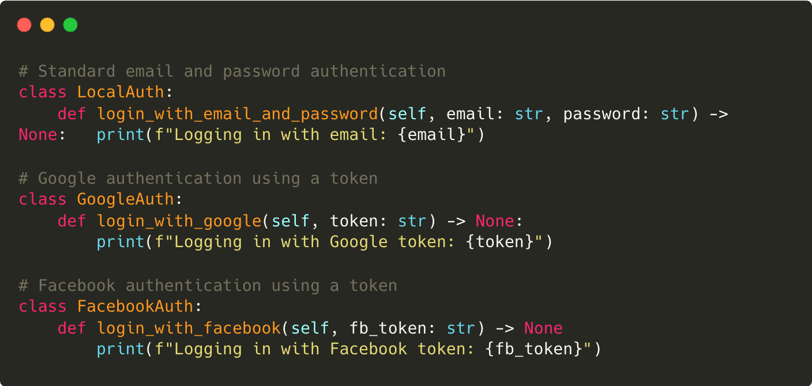
Define the Different Authentication Services
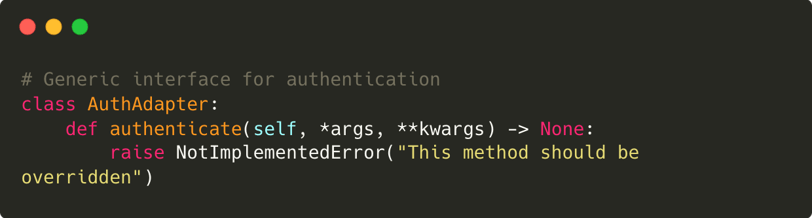
Create Adapter Classes
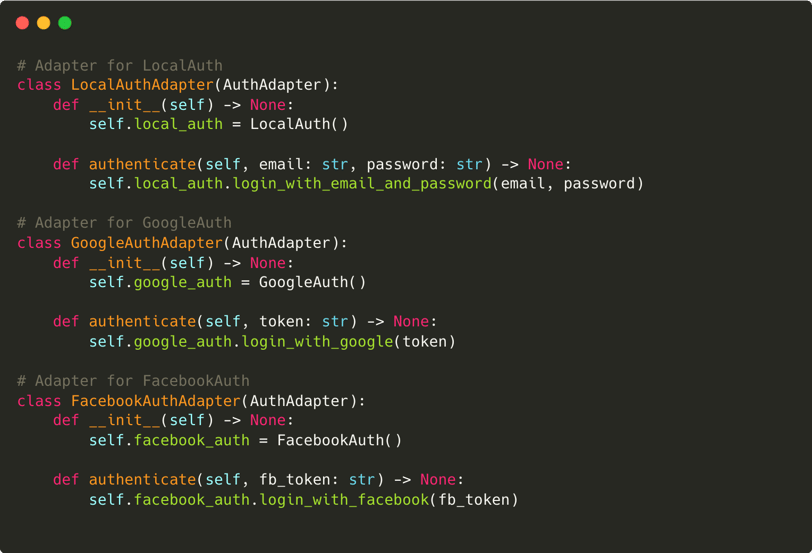
Now, create an adapter for each service that conforms to a common interface:
Override the method from AuthAdapter Class
You will have 3 adapters in total, each of which overrides the authenticate function.
This allows each adapter to handle authentication in its own specific way, depending on the underlying service. For example, LocalAuth takes username and password while GoogleAuth and FacebookAuth requires tokens.
Using the Adapters
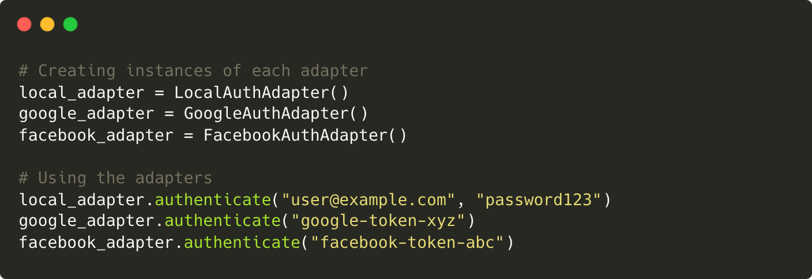
Now, you can use these adapters interchangeably:
So, when might you actually need to use the Adapter Pattern? Here are a few scenarios:
Common Use Cases for the Adapter Pattern
Integrating Third-Party APIs
Sometimes, you’re working with a third-party API that just doesn’t match up with how your application is structured. The Adapter Pattern helps smooth out those differences.
Bridging Legacy and New Systems
When you need to connect an old system to a new one without rewriting everything. Standardizing Interactions: For example, managing different payment gateways or logging systems in a consistent way.
Standardizing Interactions
If you’re dealing with multiple services—like different payment gateways or logging systems—adapters can help you manage them in a consistent way, so you’re not constantly switching gears.
There are some solid reasons to consider using the Adapter Pattern:
Why Should You Use This Design?
Centralized Control
Adapters put all the differences between services in one place, making your code easier to manage and understand.
Easy to Extend
Need to add a new service or tweak an existing one? With adapters, it’s a breeze—just modify or add a new adapter without overhauling your entire system
Let’s be real—not every situation calls for an adapter:
When to Skip the Adapter Pattern
Minimal Differences
If the services you’re dealing with are almost the same, you might be better off handling them directly rather than adding the extra layer of complexity.
Stable Services
If a service is rock-solid and unlikely to change, the time and effort to create an adapter might not be worth it.
Key Takeaways on the Adapter Design Pattern
The Adapter Design Pattern is a powerful tool for making incompatible pieces of code work together seamlessly. Whether you’re integrating third-party APIs, connecting legacy systems with new ones, or standardizing interactions across different services, adapters can simplify your code and make it more maintainable.
By centralizing differences between services, adapters allow you to manage complexity and make your system easier to extend. However, it's important to use this pattern wisely—if the services you’re dealing with are nearly identical or unlikely to change, the added complexity of an adapter might not be necessary.
Ultimately, the Adapter Pattern is about finding the right balance between abstraction and simplicity, ensuring your code remains both flexible and manageable.